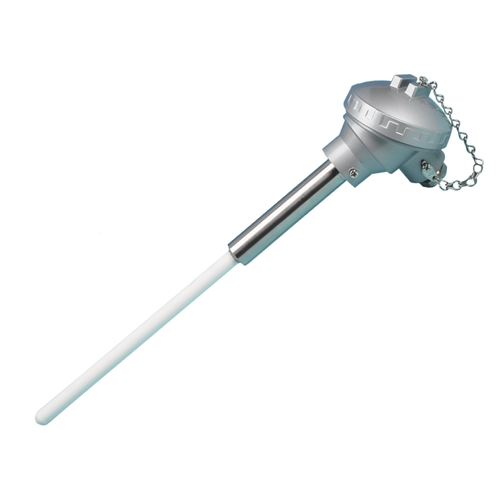
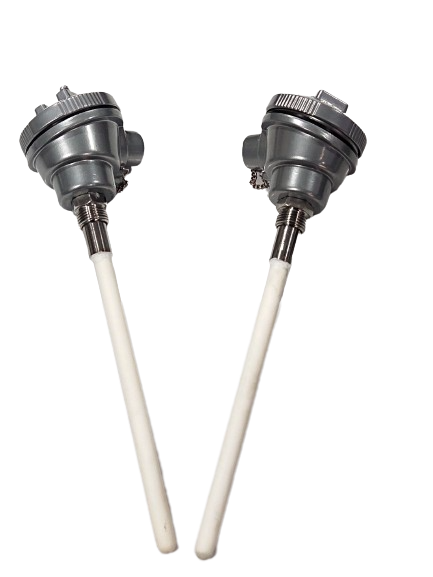
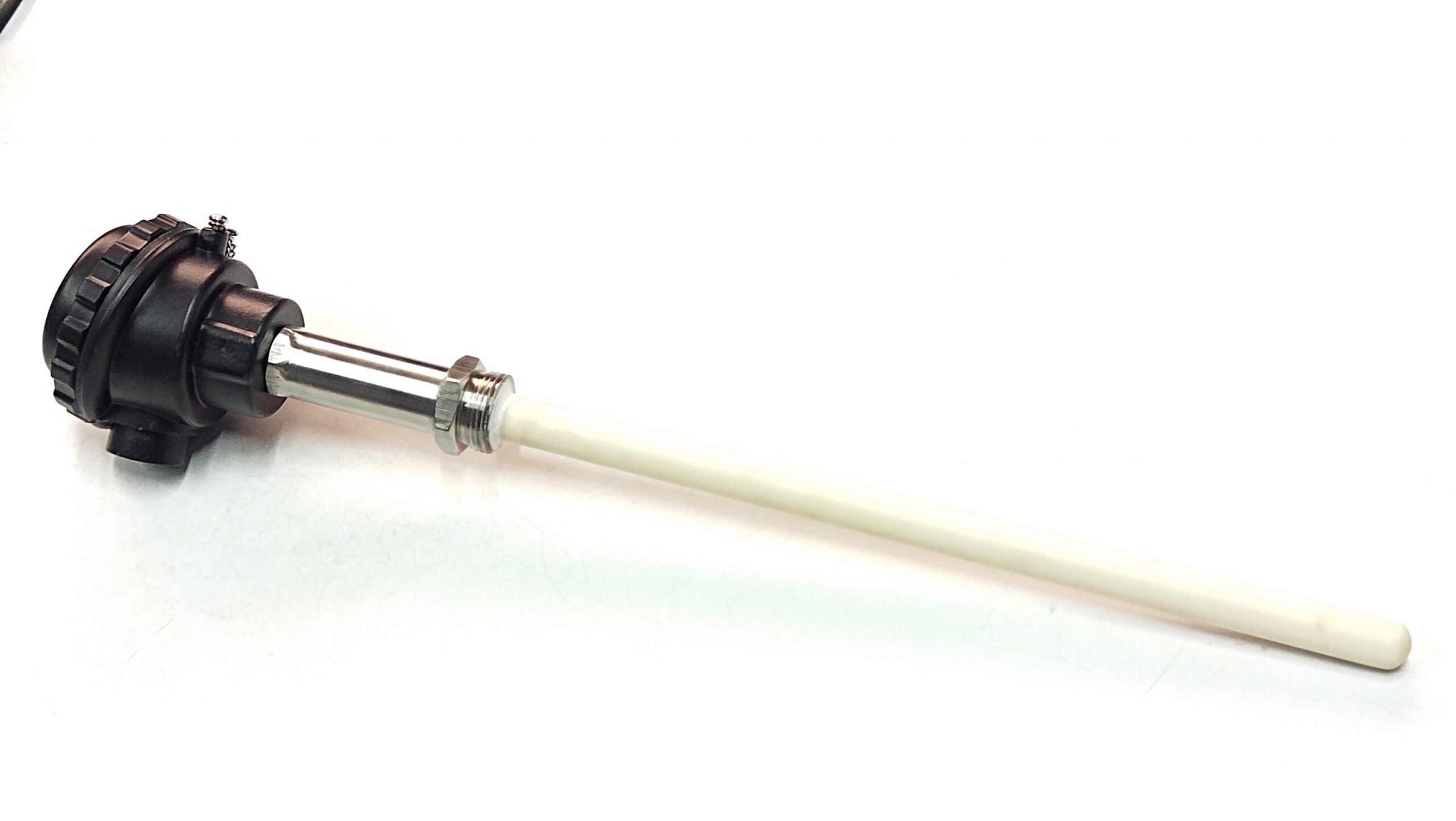
Ceramic k type high temperature thermocouple
Description
|
Type |
K ( Simplex / Duplex ) |
|
Temperature Range |
Up to 1250 ⁰C |
|
Sheath Material |
Ceramic |
|
Length |
To Suit Your Application |
|
Sheath Dia |
6, 8, 10, 12, 15, 20, 25, 28 mm |
|
Enclosure |
Weather Proof / Flame Proof |
Accurate temperature monitoring is essential for maintaining process consistency, product quality, equipment protection and operational safety Autologic Controls is a K Type Thermocouple Manufacturersupplying ceramic high-temperature thermocouples for furnaces, kilns,heat-treatment equipment, exhaust systems and demanding industrial processes across India.
Every sensor can be configured according to the required temperature insertion length, ceramic sheath diameter, element arrangement and enclosure type.
View Ceramic K-Type Thermocouple →
Reliable K Type Thermocouple Manufacturer for Industrial Applications
K Type Thermocouple Manufacturer Autologic Controls provides ceramic-sheathed sensors designed for industrial processes where standard temperature sensors may not provide suitable protection, durability or measurement stability.
A K-type thermocouple uses two dissimilar metal conductors to generate a small electrical voltage related to the temperature difference between the measuring junction and the reference point. Its broad industrial compatibility makes it a practical choice for elevated-temperature measurement.
The ceramic protection sheath provides electrical insulation and helps shield the sensing element in high-temperature environments. This construction can be suitable for applications involving intense heat, thermal cycling and process conditions where standard metallic protection tubes may not be appropriate.
The product is available in simplex and duplex configurations, customised lengths, multiple ceramic sheath diameters and weatherproof or flameproof enclosure options.
What Is a Ceramic K-Type Thermocouple?
A ceramic K-type thermocouple is an industrial temperature sensor in which the K-type measuring element is protected by a ceramic sheath. The ceramic tube helps provide heat resistance and electrical insulation while
protecting the internal thermocouple wires.
K-type thermocouples are commonly connected to compatible temperature controllers, indicators, transmitters, programmable logic controllers,data loggers and process-monitoring systems.
Working with an experienced
K Type Thermocouple Manufacturer
allows the sensor construction to be matched to the actual process temperature, atmosphere, insertion depth, response requirement and
instrumentation arrangement.
Ceramic K-Type Thermocouple Specifications
| Specification | Available Details |
|---|---|
| Thermocouple Type | K Type |
| Element Configuration | Simplex or Duplex |
| Temperature Measurement | Up to 1250°C |
| Protection Sheath | Ceramic |
| Sensor Length |
Customised according to application |
| Ceramic Sheath Diameters |
6, 8, 10, 12, 15, 20, 25 and 28 mm |
| Enclosure Options |
Weatherproof or flameproof |
| Application |
Furnaces, kilns, gas turbines, exhaust systems and industrial heating processes |
| Customisation |
Length, sheath diameter, element type and enclosure |
Final specifications should be confirmed according to the process temperature, furnace atmosphere, mounting arrangement, insertion depth,required response and connected instrument.
Key Features and Performance Benefits
Selecting a professional
K Type Thermocouple Manufacturer
helps ensure that the sensor is manufactured around the intended application instead of using one standard configuration for every process.
High-Temperature Measurement
The ceramic K-type thermocouple is available for temperature measurement up to 1250°C, making it suitable for many industrial heating, firing and thermal-processing applications.
Ceramic Protection Sheath
The ceramic sheath provides electrical insulation and thermal protection around the sensing element. It can help protect the thermocouple wires in environments where elevated heat may affect conventional protection materials.
Simplex and Duplex Configurations
A simplex thermocouple contains one measuring element. A duplex thermocouple contains two independent elements within the same assembly for separate monitoring, control or redundancy requirements.
Customised Length
The thermocouple length can be manufactured according to the equipment andrequired insertion depth. Correct length helps position the measuring junction within the intended temperature zone.
Multiple Ceramic Sheath Diameters
Available diameters include 6, 8, 10, 12, 15, 20, 25 and 28 mm. The correct diameter should be selected according to installation fit,
physical protection and response requirements.
Weatherproof and Flameproof Enclosures
Enclosure selection should be based on the surrounding environment, environmental exposure, hazardous-area requirements and applicable
plant-safety standards.
Instrument Compatibility
K-type thermocouples can be connected to compatible temperature controllers, indicators, transmitters, PLC input modules, data loggers and process-monitoring systems.
Simplex and Duplex Thermocouple Configurations
Simplex K-Type Thermocouple
A simplex configuration contains one thermocouple measuring circuit. It is suitable when a single controller, display, transmitter or
data-acquisition channel is required.
Common simplex applications include:
- General process monitoring
- Single-loop temperature control
- Local temperature indication
- Furnace-zone measurement
- Equipment testing
Duplex K-Type Thermocouple
A duplex configuration contains two independent thermocouple circuits inside one assembly. It may be selected when two separate temperature signals are required from the same measuring location.
Common duplex applications include:
-
Separate control and indication circuits
-
Independent process monitoring
- Backup temperature measurement
- Process-validation systems
-
Safety and redundancy requirements
Discuss the complete control and instrumentation arrangement with your
K Type Thermocouple Manufacturer
before selecting simplex or duplex construction.
Industrial Applications
A reliable
K Type Thermocouple Manufacturer
should evaluate the process conditions rather than recommending a senson only according to the maximum temperature.
Ceramic K-type thermocouples can be considered for:
-
Industrial Furnaces
— Temperature measurement in heating, firing and production furnaces.
-
Heat-Treatment Furnaces
— Monitoring thermal cycles during annealing, hardening, tempering and
related processes.
-
Ceramic Kilns
— Measuring kiln temperatures during ceramic firing and material
processing.
-
Foundries and Metal Processing
— Temperature monitoring in casting, forging and related
high-temperature operations.
-
Industrial Ovens and Dryers
— Process control in drying, baking, curing and heating equipment.
-
Gas Turbines and Exhaust Systems
— Monitoring elevated gas and exhaust temperatures where the selected
construction is suitable.
-
Boilers and Heating Systems
— Measuring process temperatures in industrial heating applications.
-
Incinerators
— Monitoring combustion and chamber temperatures.
-
Glass and Mineral Processing
— Temperature measurement in high-temperature production equipment.
-
Research and Testing Equipment
— Monitoring controlled high-temperature experiments and test
chambers.
Before ordering, provide information about the process atmosphere, temperature range, pressure, vibration, insertion length and surrounding environmental conditions.
Custom Ceramic Thermocouples for Your Application
Every industrial process has different installation and measurement
requirements. Working with a
K Type Thermocouple Manufacturer
that supports custom manufacturing allows the sensor to be configured around the equipment instead of forcing the equipment to accept an unsuitable standard design.
Available customisation may include:
- Overall thermocouple length
- Required insertion length
- Ceramic sheath diameter
- Simplex or duplex element
- Terminal or connection head
- Weatherproof enclosure
- Flameproof enclosure
- Process mounting arrangement
- Cable or terminal requirements
-
Connection-head orientation
- Instrument compatibility
Explore Ceramic K-Type Thermocouple →
How to Select the Right K-Type Thermocouple
Choosing the correct ceramic thermocouple requires consideration of temperature, atmosphere, response, installation conditions and connected instrumentation.
Step 1: Confirm the Temperature Range
Identify the normal operating temperature and the highest possible process temperature. Allow for realistic process variation instead of selecting a sensor only according to the normal operating point.
Step 2: Review the Process Atmosphere
Check whether the sensor will be exposed to oxidising, reducing, corrosive,dusty or chemically aggressive conditions. The selected ceramic construction should be suitable for the intended atmosphere.
Step 3: Select the Element Configuration
Choose simplex when one measuring circuit is sufficient. Select duplex when two independent signals are required from the same location.
Step 4: Determine the Correct Length
The measuring junction should reach the required process-temperature zone without positioning the terminal enclosure too close to excessive heat.
Step 5: Choose the Sheath Diameter
The sheath diameter influences physical strength, installation fit and response. Confirm that the selected size can enter the existing opening or process connection.
Step 6: Select the Enclosure
Choose a weatherproof or flameproof enclosure according to the installation environment and applicable plant requirements.
Step 7: Confirm Instrument Compatibility
Check the thermocouple input type, polarity, extension cable, compensation cable, controller configuration and terminal connection.
Step 8: Share the Application Details
A professional
K Type Thermocouple Manufacturer
can review your process information and recommend a suitable construction for the intended installation.
Information Required for Product Selection
Share the following information when requesting a recommendation or
quotation:
| Required Detail | Information to Provide |
|---|---|
| Operating Temperature |
Normal and maximum process temperature |
| Application |
Furnace, kiln, oven, exhaust system or other equipment |
| Process Atmosphere |
Oxidising, reducing, corrosive, dusty or another condition |
| Element Configuration | Simplex or duplex |
| Sensor Length |
Overall length and insertion length |
| Sheath Diameter |
Required size or available installation opening |
| Mounting |
Existing connection, flange, thread or support arrangement |
| Enclosure |
Weatherproof or flameproof requirement |
| Instrument |
Controller, indicator, PLC, transmitter or data logger |
| Quantity |
Required quantity and repeat requirement |
Installation Recommendations
Correct installation is important for stable and representative temperature measurement.
-
Position the sensing end inside the actual process-temperature zone.
-
Avoid shallow insertion that may measure wall or ambient temperature.
-
Protect the ceramic sheath from impact during transport and
installation.
-
Do not force the sensor into a damaged or misaligned opening.
-
Provide suitable support for long thermocouple assemblies.
-
Use compatible K-type extension or compensating cable.
-
Maintain correct positive and negative polarity.
-
Keep thermocouple wiring away from high-power electrical cables where
possible.
-
Tighten terminal connections correctly.
-
Configure the connected instrument for K-type input.
-
Inspect the sensor periodically for cracks, contamination or terminal
damage.
Installation should be completed by technically qualified personnel in accordance with the equipment requirements and site-safety procedures.
Ceramic Thermocouple Care and Maintenance
Avoid Mechanical Shock
Ceramic protection tubes can be damaged by impact, bending force or careless handling. Transport and install the sensor carefully.
Limit Sudden Thermal Shock
Where the process allows, avoid exposing a cold ceramic sheath immediately to extreme temperature. Rapid temperature changes may increase the risk of ceramic cracking.
Inspect the Protection Tube
Check the ceramic tube for visible cracks, contamination, surface damageor deterioration during scheduled maintenance.
Check Electrical Connections
Loose, damaged or oxidised terminals may cause unstable readings. Inspect the connection head, wiring and extension cable periodically.
Verify the Temperature Reading
Compare the sensor reading with expected process conditions or a suitable reference during maintenance. Replace the thermocouple when damage or drift affects measurement reliability.
Follow the Application Limits
Do not exceed the specified temperature, mechanical or environmental limits of the selected configuration.
Why Choose Autologic Controls?
Application-Specific Manufacturing
Autologic Controls configures thermocouples according to process temperature, required length, sheath diameter, element arrangement and enclosure requirements.
Simplex and Duplex Options
Select one measuring circuit for general monitoring or two independent circuits for separate control, indication or redundancy.
Multiple Ceramic Sheath Sizes
Available diameters provide flexibility for different insertion openings, process conditions and mechanical requirements.
Weatherproof and Flameproof Options
Connection-head and enclosure options can be selected according to the installation environment and plant requirements.
Related Temperature-Control Products
Autologic Controls also supplies thermocouples, RTD sensors, thermowells, cables, temperature controllers and related industrial instrumentation.
Technical Product-Selection Support
Choosing Autologic Controls as your
K Type Thermocouple Manufacturer
provides access to application-based product selection and customised sensor enquiries.
Frequently Asked Questions
1. What is a ceramic K-type thermocouple?
A ceramic K-type thermocouple is a temperature sensor with a K-type measuring element protected by a ceramic sheath. It is commonly considered for furnaces, kilns, exhaust systems and industrial heating equipment.
2. What is the temperature range of this thermocouple?
The listed temperature-measurement range is up to 1250°C. Actual suitability depends on the process atmosphere, selected construction,
exposure period and installation conditions.
3. Is the thermocouple available in simplex and duplex configurations?
Yes. Simplex provides one measurement circuit, while duplex provides two independent measuring circuits within the same assembly.
4. Which ceramic sheath diameters are available?
Available diameters include 6, 8, 10, 12, 15, 20, 25 and 28 mm. The suitable diameter depends on the installation opening, physical
protection and response requirements.
5. Can the thermocouple length be customised?
Yes. The overall length and insertion length can be manufactured according to the application and required measuring-point position.
6. Where are ceramic K-type thermocouples used?
They can be considered for industrial furnaces, kilns, ovens, heat-treatment equipment, foundries, exhaust systems, gas turbines,
incinerators and other high-temperature processes.
7. Are weatherproof and flameproof enclosures available?
Yes. Weatherproof and flameproof enclosure options are available.Selection should be based on the installation environment and applicable plant-safety requirements.
8. How do I choose a K Type Thermocouple Manufacturer?
Choose a
K Type Thermocouple Manufacturer
that reviews the process temperature, atmosphere, sensor length, sheath diameter, element configuration, mounting arrangement and enclosure requirement before recommending a product.
Request a Ceramic K-Type Thermocouple Quote
Requesting a quote from a
K Type Thermocouple Manufacturer
is easier when you provide complete technical and installation
information.
Share your normal and maximum operating temperature, process atmosphere,required length, sheath diameter, simplex or duplex preference, mounting details, enclosure requirement and quantity.
Partner with an experienced
K Type Thermocouple Manufacturer
for a ceramic high-temperature sensor configured around your industrial
process.
+91 9099001611